
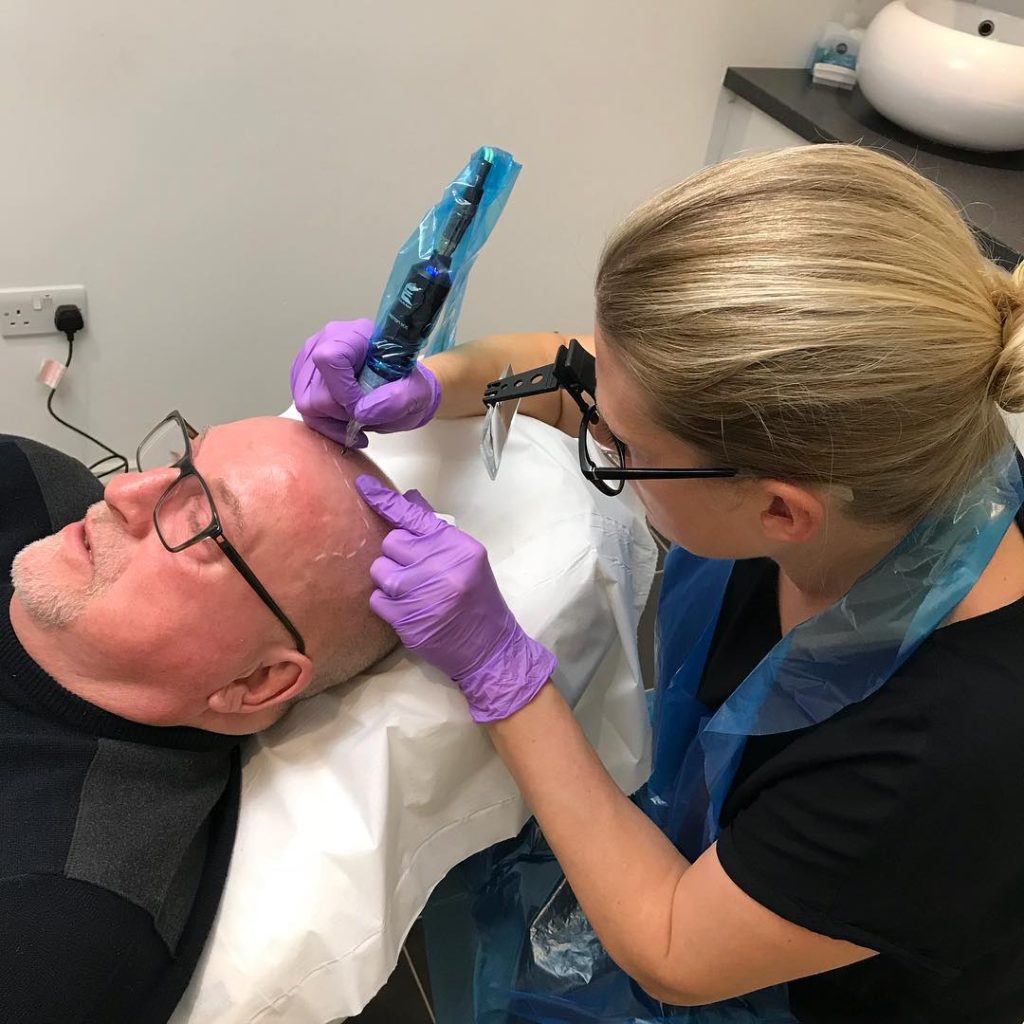
If you’ve been researching hair loss solutions and keep coming across the term scalp micropigmentation, you’re in exactly the right place. I’m Charlotte, founder of Simply Scalp, and I’ve dedicated my career to this treatment because I’ve seen first-hand what it does for people’s confidence.
Whether you’re just starting your research or you’re nearly ready to book, this guide will walk you through everything you need to know, clearly and honestly.
What Is Scalp Micropigmentation?
Scalp micropigmentation, or SMP, is a non-surgical hair loss treatment that uses specialised pigment to replicate the natural appearance of hair follicles on the scalp. The result is the look of a freshly shaved head, a denser hairline, or improved coverage across areas affected by thinning and hair loss.
It’s sometimes compared to tattooing, and while the two share some surface-level similarities, SMP is a very different discipline. The equipment, technique, pigment formulation and application depth are all specifically developed for the scalp. The goal isn’t to create art on skin. It’s to recreate something that looks entirely natural and indistinguishable from real hair follicles.
How Does SMP Actually Work?
The process involves depositing tiny impressions of pigment into the upper layers of the scalp, carefully positioned to mimic the pattern, density and distribution of natural hair follicles. Each point of pigment is placed with precision, taking into account your skin tone, natural hair colour, hair loss pattern and the hairline shape that suits your face.
At Simply Scalp, no two treatments are the same. Every client’s scalp is unique, every hairline is unique, and the approach I take reflects that. This level of bespoke attention is what separates a genuinely great SMP result from one that looks unconvincing.
Who Is SMP Suitable For?
One of the things I love most about scalp micropigmentation is how versatile it is. It works across a wide range of hair loss conditions and concerns, including:
- Male pattern baldness (androgenetic alopecia)
- Female hair thinning and diffuse hair loss
- Alopecia areata, totalis and universalis
- Traction alopecia
- Hair loss associated with chemotherapy
- Scarring from hair transplants, injuries or surgeries
- Fine or thinning hair lacking visual density
Whether you’re completely bald, dealing with patchy loss or simply want your hair to look thicker and fuller, SMP can be tailored to your specific situation. It’s suitable for men and women, across all skin tones and hair colours, which is genuinely rare for a cosmetic treatment of this kind.
What Can You Expect From the Process?
SMP is always carried out across a structured course of sessions rather than a single appointment. This multi-session approach is fundamental to achieving a result that looks layered, realistic and long-lasting. Here’s how the process typically unfolds:

- Consultation: Before anything else, we sit down and talk through your goals. I assess your scalp, discuss your hair loss history, design your hairline and agree on the pigment shade. This stage is just as important as the treatment itself.
- Session 1: The foundation is laid. We establish the hairline, begin building coverage and start matching pigment precisely to your skin tone and natural hair colour.
- Session 2: We build on the first session, adding depth, density and dimension. This is where the result begins to take real shape.
- Session 3: The finishing session. We refine, perfect and finalise every detail. Fine adjustments are made to ensure the overall result is seamless and natural-looking from every angle.
Sessions are typically spaced around 10 to 14 days apart to allow the skin to settle and heal properly between appointments. The full treatment course usually spans four to six weeks from start to finish.
How Many Sessions Does SMP Require?
Every client at Simply Scalp completes 3 sessions. This is the case regardless of the extent of hair loss. Even clients with mild thinning require all 3 sessions to achieve a result that is durable, natural and well-layered over time.
I know it can be tempting to assume that less severe hair loss means less treatment, but that’s not how quality SMP works. The layered approach across 3 sessions is what creates the depth and realism that makes the treatment look genuinely convincing, whether you’re covering minimal thinning or complete baldness.
Is Scalp Micropigmentation Painful?
This is one of the first questions most clients ask, and I’m always happy to reassure them. The vast majority of clients are genuinely surprised by how comfortable SMP is. The sensation is most commonly described as light scratching or tapping, and most people find it very manageable throughout the session.
If you have concerns about discomfort, oral pain relief available over the counter in the UK is an option worth considering. I’d recommend speaking with your GP or a qualified healthcare professional for advice specific to you before your appointment.
What Do SMP Results Look Like?
When SMP is done well, it should be completely undetectable. The aim is always a result that looks like your own hair, not a cosmetic procedure you’ve undergone. Clients regularly tell me that their friends and family haven’t noticed anything specific. They just notice the person looks better, more confident, more like themselves.

The finished aesthetic depends on the style you choose. For clients with significant hair loss, the result typically replicates the look of a closely shaved head with a clean, defined hairline. For clients with thinning hair, the treatment adds the visual impression of greater density and fullness. In both cases, the result is subtle, natural and built entirely around your individual features.
How Long Does SMP Last?
Scalp micropigmentation is considered a semi-permanent treatment. The pigment sits in the upper dermis of the scalp and will lighten gradually over time, influenced by sun exposure, skin cell turnover and individual lifestyle factors. Most clients find the results remain strong for three to five years before a refresh is needed, though this varies from person to person.
A refresh session is a simple top-up that restores the depth and definition of the original result. It’s far quicker and more straightforward than the initial course of treatment, and most clients only need one refresh session to bring everything back to its best.
Why SMP Versus Other Hair Loss Treatments?
There are various hair loss options available, from medications to surgical transplants, and they all have their place for the right person. But SMP offers something genuinely different. It’s immediate, non-surgical, low maintenance and accessible to people who aren’t suitable candidates for a transplant, or who simply don’t want one.
There are no ongoing prescriptions to manage, no long recovery periods and no uncertainty about whether the treatment will work. You complete your 3 sessions and you leave with a finished result. That combination of reliability, immediacy and the confidence it restores is exactly why I built Simply Scalp around this treatment.
Is SMP Right for You?
If you’re experiencing any form of hair loss and it’s affecting how you feel about yourself, SMP is almost certainly worth exploring. It works across an exceptionally wide range of hair loss types, skin tones and lifestyles, and the results speak for themselves.
The best place to start is always a consultation. It costs nothing to have a conversation, and it gives you the information you need to make a confident, informed decision about your options. I’m always happy to answer questions and talk through what SMP could realistically do for you specifically.
Frequently Asked Questions
Q1: What is scalp micropigmentation and how is it different from a tattoo?
Scalp micropigmentation is a specialist cosmetic procedure that deposits pigment into the upper layers of the scalp to replicate the appearance of natural hair follicles. While it shares a surface-level similarity with tattooing in that pigment is introduced into the skin, the two are very different in practice. SMP uses equipment, needles and pigment formulations specifically designed for the scalp. The application depth is shallower than a traditional tattoo, the pigment is formulated to avoid the colour shifts that standard tattoo ink can produce over time, and the technique focuses on creating tiny, follicle-like impressions rather than solid colour fills or line work. The goal of SMP is always realism and subtlety, producing a result that looks entirely natural and indistinguishable from real hair stubble or a fuller hairline. It requires specialist training and a thorough understanding of scalp anatomy, skin tones and hair loss patterns, which is why practitioner skill and experience matter so much.
Q2: How many SMP sessions will I need?
Every client at Simply Scalp completes 3 sessions, regardless of the degree of hair loss. This applies whether you have mild thinning, significant hair loss or complete baldness. The 3-session structure is not arbitrary. It is the method that produces results with genuine depth, dimension and longevity. Each session builds upon the last, with pigment layered progressively to create a natural, realistic finish that holds up well over time. Trying to achieve the same result in fewer sessions would compromise the quality of the outcome significantly. Sessions are typically scheduled 10 to 14 days apart to allow the skin to heal fully between appointments, meaning the full treatment course usually takes between four and six weeks to complete from your first session to your last.
Q3: Does scalp micropigmentation hurt?
Most clients are genuinely surprised by how comfortable SMP is. The sensation during treatment is commonly described as a light scratching or repetitive tapping, and the overwhelming majority of clients find it very manageable from start to finish. Some areas of the scalp are marginally more sensitive than others, but overall the treatment is considered low on the discomfort scale. If you’re personally concerned about discomfort, over-the-counter oral pain relief available in the UK is something you could consider. I’d recommend discussing this with your GP or a suitable healthcare professional before your appointment, as they’re best placed to advise you based on your individual health and circumstances.
Q4: How long does scalp micropigmentation last?
SMP is a semi-permanent treatment, meaning the results will gradually lighten over time rather than remaining completely fixed. For most clients, the treatment looks strong and consistent for approximately three to five years before a refresh session becomes worthwhile. The rate at which the pigment fades is influenced by factors including sun exposure, skin type, how well aftercare instructions are followed and individual lifestyle habits. Clients with oilier skin types or those who spend significant time in direct sunlight may notice fading slightly earlier. A refresh session is a straightforward top-up procedure that restores the depth, definition and vibrancy of the original treatment. It is considerably quicker and simpler than the initial course of 3 sessions, and for most clients, a single refresh is all that’s needed to bring the result back to its best.
Q5: Can SMP help with alopecia?
Yes, SMP is an excellent option for many people affected by alopecia, including alopecia areata, alopecia totalis and alopecia universalis. For clients with patchy hair loss caused by alopecia areata, SMP can be used to camouflage and blend affected areas, creating a more uniform appearance. For those with complete scalp hair loss from alopecia totalis or universalis, SMP replicates the appearance of a closely shaved head across the entire scalp, restoring a defined, natural-looking aesthetic. It’s worth noting that because alopecia can be unpredictable in some cases, particularly where there is active or fluctuating hair loss, a thorough consultation is especially important to ensure SMP is the right choice at the right time for your individual situation. I always take the time to understand a client’s hair loss history before recommending we go ahead.
Q6: What is the difference between SMP for hair loss and SMP for hair density?
These are two distinct applications of the same technique, and both are something we regularly treat at Simply Scalp. SMP for hair loss, most commonly associated with male pattern baldness, alopecia or scarring, focuses on creating the appearance of a shaved head or restoring a natural hairline across areas with significant or total hair loss. SMP for hair density, on the other hand, is suited to clients who still have existing hair but whose scalp shows through due to thinning or fine hair. In this case, pigment is worked into the scalp between existing hairs to create the visual impression of greater thickness and fullness. The two approaches require different considerations in terms of pigment placement, shade selection and technique, and both require the same 3-session treatment structure to achieve results that are layered, realistic and durable.