One of the most common questions I hear from people considering scalp micropigmentation is: “How many sessions will I actually need?” It’s a completely fair question, and I want to give you a genuinely useful answer rather than a vague “it depends.”
The truth is, SMP always requires more than one session, and understanding why will help you set realistic expectations from the start.
Every SMP Treatment Requires 3 Sessions
At Simply Scalp, every client undergoes 3 sessions, regardless of the extent of their hair loss. This is not a variable or something we negotiate on. It is the clinical standard required to achieve a result that is natural-looking, even in tone, and built to last.
Some people come to me hoping to get it done in one or two visits. I completely understand the appeal, but cutting sessions short almost always leads to patchy, inconsistent results that fade unevenly and end up requiring corrective work later. Three sessions is the process, and it exists for very good reasons.
Why Multiple Sessions Are Necessary
Scalp micropigmentation works by depositing pigment into the upper layers of the dermis in a series of carefully placed impressions that replicate the appearance of hair follicles. The skin needs time to settle, heal, and show how it has retained the pigment before the next layer of work is applied.
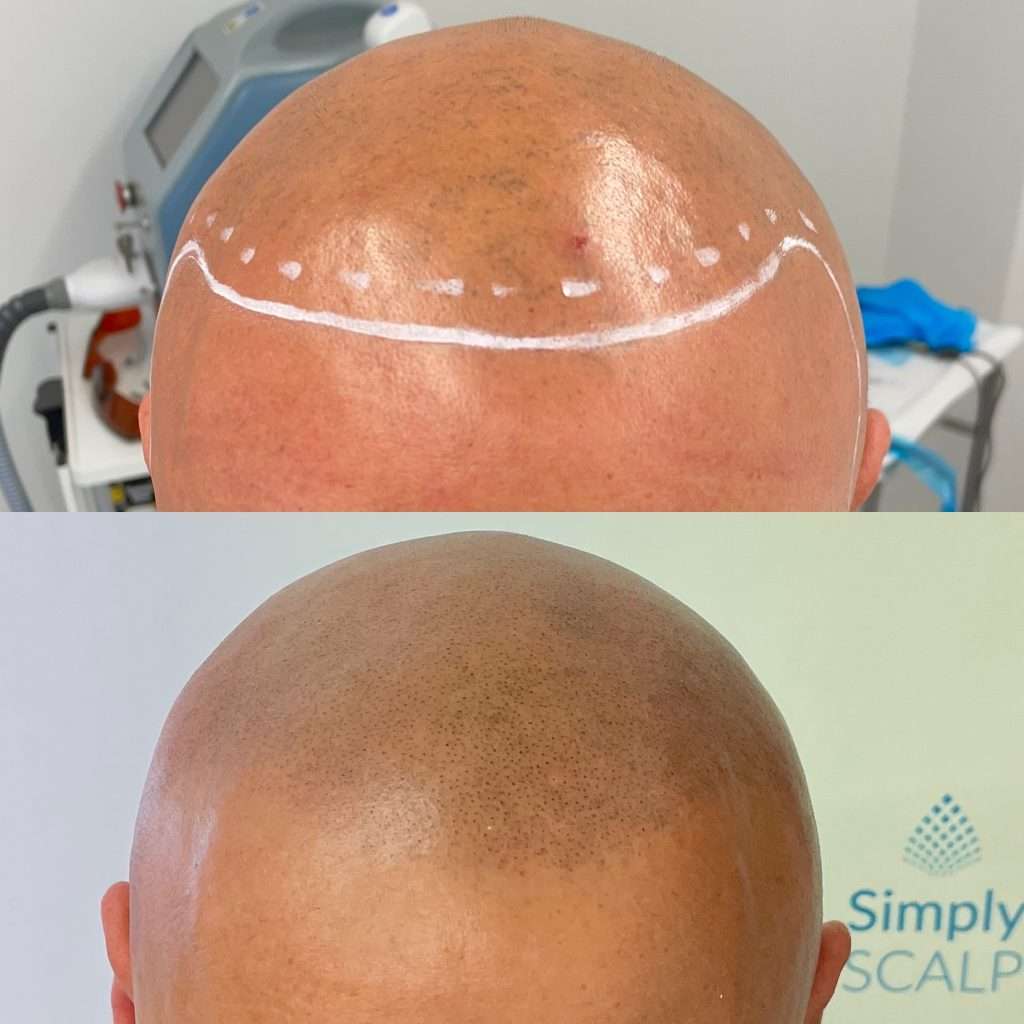
Each session builds on the last. The first session establishes the foundation, including hairline placement and the initial layer of pigment. The second session adds density, definition, and begins to create a more three-dimensional, realistic appearance. The third session is about refinement: balancing tone, adjusting any areas where pigment retention was lighter, and completing the overall look to a finished standard.
Skipping or compressing this process means you never give the skin the opportunity to show you exactly what it needs. At Simply Scalp, I assess each client’s results between sessions before deciding precisely how the next session should be approached.
Factors That Influence How Your Treatment Progresses
While every client follows the same 3-session structure, there are several factors that influence how intensive each session needs to be, how much work is required per visit, and how the overall treatment plan is shaped.

The Extent of Hair Loss
The surface area being treated has a direct impact on how much time and work is involved per session. A client with a receding hairline requires significantly less work per session than someone with advanced hair loss across the entire scalp. Both require 3 sessions, but the scope and duration of each session will differ. Norwood scale classifications are often used as a reference point in the industry to help describe and plan for different levels of androgenetic alopecia.
Skin Type and Scalp Condition
Skin type plays a meaningful role in how pigment behaves during and after treatment. Oily skin, for example, tends to result in slightly softer-looking impressions due to how the sebaceous glands interact with pigment. Very dry or mature skin can sometimes absorb pigment differently, requiring careful technique adjustments. Scarred skin, particularly from hair transplant procedures, presents its own challenges since scar tissue holds pigment differently from healthy skin and often requires additional attention during sessions.
At Simply Scalp, I carry out a thorough consultation before treatment begins so that I understand your scalp’s specific characteristics. This directly informs how I approach each session.
Previous SMP or Tattoo Work on the Scalp
If you have had a previous SMP treatment elsewhere, or if you have tattoo work on or near the scalp, this affects how your sessions need to be structured. Existing pigment can influence colour matching, depth of work, and how clearly new impressions can be placed. Corrective SMP cases generally require more careful planning and a measured approach across all 3 sessions.
Desired Density and Coverage Style
The look you are going for also shapes how your treatment progresses. A very close-shaved, dense appearance requires a different density of work than a softer, lower-contrast finish. Some clients want a tight, sharp hairline while others prefer something that blends more gradually. These preferences are discussed during your consultation and are revisited at each session as the result develops.
Pigment Retention Between Sessions
Everyone’s skin retains pigment slightly differently. After the first session especially, it is common for some areas to appear lighter once the skin has healed. This is completely normal and expected, which is precisely why subsequent sessions are built into the plan. The way your skin retains the initial work tells me a great deal about how to approach sessions two and three. This is one of the key reasons why trying to rush the process or combine sessions is counterproductive.
How Long Do You Wait Between Sessions?
At Simply Scalp, sessions are typically spaced 10 to 14 days apart. This allows the skin adequate healing time while keeping your overall treatment timeline manageable. Rushing the gap risks working on skin that has not fully settled. Leaving it too long is generally not a clinical concern, but it does extend the time before you see your finished result.
Most clients complete all 3 sessions within 4 to 6 weeks from start to finish, though this can flex slightly around your schedule and skin’s healing response.
What About Touch-Ups After the Initial Treatment?
Once your 3-session course is complete and your result has fully settled, the treatment is considered finished. Over time, as with any cosmetic pigmentation procedure, some fading is natural. Many clients return for a maintenance top-up session every few years to refresh the appearance and maintain density. This is a single session in most cases, not a repeat of the full treatment course.

At Simply Scalp, I always recommend waiting until the treatment has fully settled and reviewing the result properly before considering any additional work. There is no pressure, and there is no benefit to rushing a top-up before one is needed.
Why Getting This Right From the Start Matters
I have had clients come to me for corrective work after treatment elsewhere that was either carried out in fewer sessions than appropriate, or where the practitioner applied too much pigment too quickly in an attempt to speed up the process. The result in those cases is almost always harder to work with than starting from scratch, and it can significantly limit what is achievable in terms of a natural finish.
Three sessions, carried out with proper spacing and a measured technique, is not just industry convention. It is genuinely the most effective and safest way to deliver a result that looks right, holds well, and gives you the confidence you came for in the first place.
If you have questions about your specific situation or want to talk through what your treatment plan might look like, I am always happy to chat. You can book a free consultation with me directly, and we will go through everything before you commit to anything.
Frequently Asked Questions
Q1: Why do I need 3 sessions and not just one or two?
SMP is a layered process. The skin needs time to heal between sessions, and each visit builds on the last. The first session lays the foundation and establishes the hairline and overall design. The second session adds depth and density. The third session refines the result, balances tone, and addresses any areas where pigment retention was lighter. Attempting to complete SMP in fewer sessions means skipping critical stages of the process. The result would be uneven, inconsistent, and unlikely to hold well over time. Three sessions is the clinical minimum to deliver a finish that looks natural and lasts. At Simply Scalp, this structure applies to every client regardless of the extent of their hair loss.
Q2: Does hair loss severity affect how many sessions I need?
The extent of your hair loss affects the scope and intensity of each session, but every client still requires 3 sessions in total. Someone with early-stage hair loss around the temples will have less surface area to cover per session compared to someone with more advanced, diffuse hair loss across the whole scalp. The difference lies in how much work is involved per visit and how treatment is prioritised across the 3 sessions, not in reducing or increasing the number of sessions. At Simply Scalp, I carry out a thorough consultation before treatment begins so that your 3-session plan is mapped out specifically for your level of hair loss and your goals.
Q3: How long does it take to complete all 3 sessions?
Most clients at Simply Scalp complete all 3 sessions within 4 to 6 weeks from their first appointment. Sessions are typically spaced 10 to 14 days apart to allow the skin to heal properly between visits. This spacing is important because working on skin that has not fully settled can interfere with pigment placement and affect the quality of the final result. If you need to extend the gap slightly due to your schedule, this is not usually a clinical concern. What matters is that you allow adequate healing time between each session rather than trying to compress the timeline. The full result, once the third session has healed, is typically visible within a few days of your final appointment.
Q4: Will I need a top-up session after my initial treatment?
Once your 3-session course is complete, the treatment is finished and no further sessions are required immediately. Over time, some natural fading is expected with any cosmetic pigmentation procedure, and many clients choose to return for a single maintenance top-up session every few years to keep the result looking fresh and dense. This is not always necessary for everyone and depends on factors such as skin type, lifestyle, and sun exposure. At Simply Scalp, I always recommend allowing the result to fully settle after your third session before deciding whether any additional work is needed. There is never any pressure, and a good SMP result should hold well for several years before a refresh becomes worthwhile.
Q5: Does skin type affect how my SMP sessions are approached?
Yes, skin type is one of the most important factors I assess before and during treatment. Oily skin can cause pigment impressions to appear slightly softer at the edges due to sebum activity, which influences the technique and needle depth used. Dry or mature skin may absorb pigment differently and sometimes shows lighter retention in certain areas after healing. Scarred skin, such as from a previous hair transplant, holds pigment differently from healthy skin and requires careful technique adjustments. None of these factors change the number of sessions required, but they do directly shape how I approach each session and what I focus on at each stage. This is why the consultation process at Simply Scalp is so detailed before any treatment begins.
Q6: Is SMP painful, and do I need anything to manage discomfort?
Most clients are genuinely surprised by how comfortable the procedure is. Pain levels are typically very low, and the vast majority of people tolerate each session without any issue. The scalp can be more sensitive in certain areas, and individual pain thresholds vary, but discomfort is rarely a significant concern for clients at Simply Scalp. At Simply Scalp, we do not use any topical products to manage sensation during treatment, as this can compromise the quality of the SMP result. If you are considering taking an over-the-counter oral painkiller before your appointment, please speak to your GP or a suitable healthcare professional for guidance, as this is something we are unable to advise on directly. Most clients find they simply do not need anything at all.