
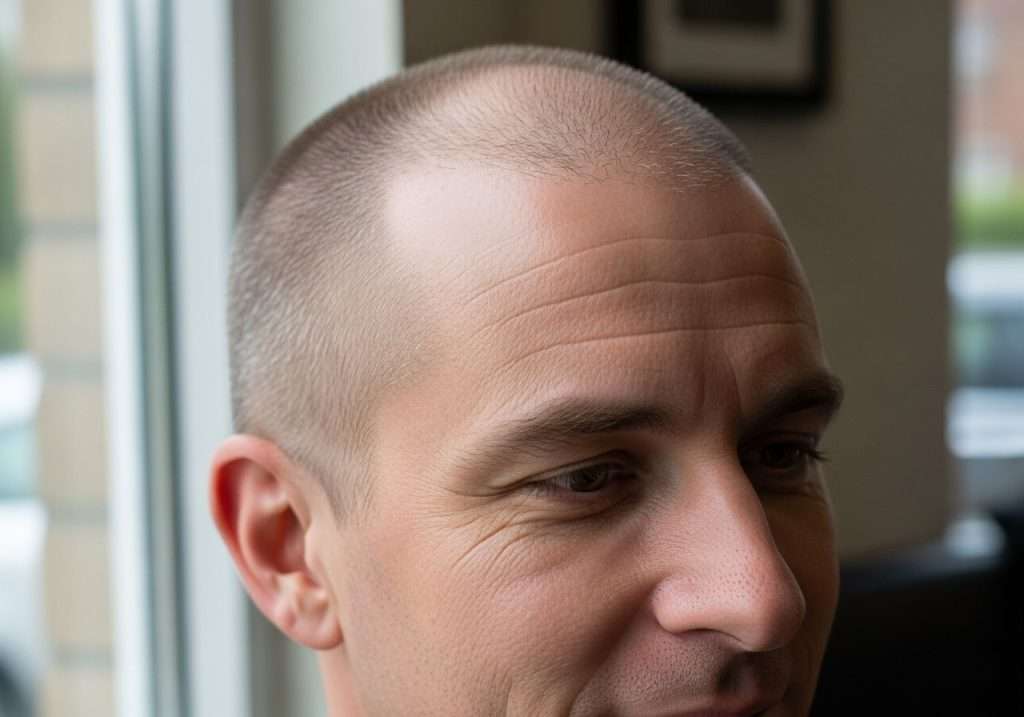
Can SMP fix thinning hair, or is it only for bald heads?
You’ve still got hair. It’s just thinner than it used to be, and you can see your scalp shining through under bright light or in photos. You’re wondering whether scalp micropigmentation is only for men who’ve gone fully bald, or whether it can help when there’s still hair there, just not enough of it. It can, and this article explains exactly how.
Scalp micropigmentation for thinning hair men search for most often works differently to the shaved-head version people picture. Rather than covering a bald scalp with an even pattern, pigment dots are worked into and around your existing hair, matching the tone of your scalp to the tone of your hair so the contrast that makes thinning obvious simply disappears. It’s a density illusion, built dot by dot with a needle depositing pigment roughly 1.5 to 2mm into the skin.
This is male density SMP in its most common form: not a shaved look, but a thickened, denser looking head of hair that still moves and behaves like your own, because it is your own, just visually reinforced.
How many sessions thinning hair actually needs
Most men with thinning hair, rather than total baldness, need two to three sessions. Compare that to three or four for a fully shaved SMP result, and you’ll see why: there’s already hair doing some of the work, so the process involves filling in gaps and reducing scalp show-through rather than building an entire illusion from bare skin.
Each session runs one to three hours depending on how much area is being covered, and sessions are typically spaced three to four weeks apart. That gap matters. It lets the pigment settle and allows the practitioner to see exactly how your skin has held the previous layer before deciding where the next layer needs to go.
The first session is deliberately conservative. It uses a lower dot density, somewhere around 40 dots per square centimetre, working carefully around your existing hairline and through the thinning patches. By the final session, density builds towards 80 to 100 dots per square centimetre in the areas that need it most, always checked against your actual hair colour and the natural irregularity of a real hairline, because nothing looks worse than a dead-straight, uniform edge.
Numbing cream isn’t used as standard for this work. Most men find the discomfort manageable, similar to a scratchy, warm sensation rather than sharp pain, but if you’d rather not risk any discomfort, you’re welcome to apply a topical numbing cream before your appointment. Just mention it in advance so timing can be discussed.
What healed results look like next to the freshly treated scalp
Here’s something worth knowing before you book: your scalp will look darker and more solid immediately after each session than it will once healed. That’s normal, and it catches people off guard if nobody warns them.
In the first four days, you’ll have redness and the pigment will sit quite boldly on the surface. No water on your scalp, no shampoo, no sweating, no shaving during this window. Between days five and ten, you can wash gently, but you need to stay out of direct sun. By day ten, you can wear SPF and get back to normal grooming, though swimming pools are off the table for a full 28 days while the skin completes its healing cycle.
As the top layer of skin turns over, roughly 27 days for the epidermis to fully renew, some of that initial boldness fades. What’s left is softer, more diffuse, and considerably more natural than the fresh result. This is exactly why clients shouldn’t judge their outcome from days one to ten. The healed result, visible around the one-month mark, is the true result, and it consistently looks better than people expect once they’ve seen it settle.
Who this suits, and who should look elsewhere
Strong candidates for this approach have diffuse thinning across the crown or mid-scalp, a receding hairline they want redefined and thickened, or early-stage male pattern hair loss where there’s still hair to work with but the scalp is becoming visible. Scarring from previous procedures or old injuries can also be camouflaged this way, blending the scar tone into the surrounding scalp and hair.
It suits men who’ve accepted that this won’t bring hair back. SMP doesn’t stimulate follicles, doesn’t affect the hair growth cycle, and won’t regrow a single strand. What it does is reduce the visual gap between scalp and hair so thinning reads as deliberate rather than accidental.
It’s not the right first step for anyone with active scalp acne, a current psoriasis or eczema flare, or a strong history of keloid scarring, since healing needs calm, settled skin. If your hair loss is still progressing quickly and unpredictably, it’s worth discussing timing carefully at consultation, because further thinning around treated areas can change how the pattern reads over time. For some men, a hair transplant, or a combination of transplant and SMP for added density, is the better route, and that’s a conversation worth having honestly before committing to either.
On longevity: expect results to hold for four to eight years before they need refreshing. Touch-ups every four to six years are typical, and they’re usually shorter, simpler sessions than the original treatment. Sun exposure, oily skin, and skipping SPF all speed up fading, so a daily SPF 30 to 50 on the scalp genuinely extends how long results stay sharp.
Frequently Asked Questions
Can scalp micropigmentation work if I still have most of my hair?
Yes. SMP for thinning hair blends pigment dots between and around your existing strands rather than covering bare skin, reducing the scalp-to-hair contrast that makes thinning visible. Most men in this situation need fewer sessions than a full head treatment, typically two to three.
Will SMP make my thinning hair grow back thicker?
No. Scalp micropigmentation doesn’t affect hair follicles or stimulate regrowth. It’s a cosmetic technique that camouflages thinning by matching pigment to your scalp and hair tone, making density look fuller without changing the underlying hair loss.
How soon will I know if the results look right?
Not immediately. The scalp looks darker and bolder for the first week to ten days after each session. The true healed result appears around day 28 to 30, once the top skin layer has fully renewed, so judge the outcome then, not straight after treatment.
Is scalp micropigmentation for hair loss men in the UK regulated?
SMP sits within cosmetic tattooing regulation in the UK, meaning practitioners need local authority licensing for the premises and hold certifications in bloodborne pathogens and cross-contamination control, rather than a dedicated medical licence specific to SMP.
Do I need numbing cream for treatment on thinning areas?
Not as standard. Most clients manage the sensation comfortably without it, describing it as a warm, scratchy feeling rather than sharp pain. If you’d prefer extra comfort, you can apply a topical numbing cream beforehand, just mention it when booking.
Ready to talk it through?
Simply Scalp in Purley offers a personal consultation to answer your questions and recommend the right approach for you. Get in touch with Simply Scalp to book your consultation.