
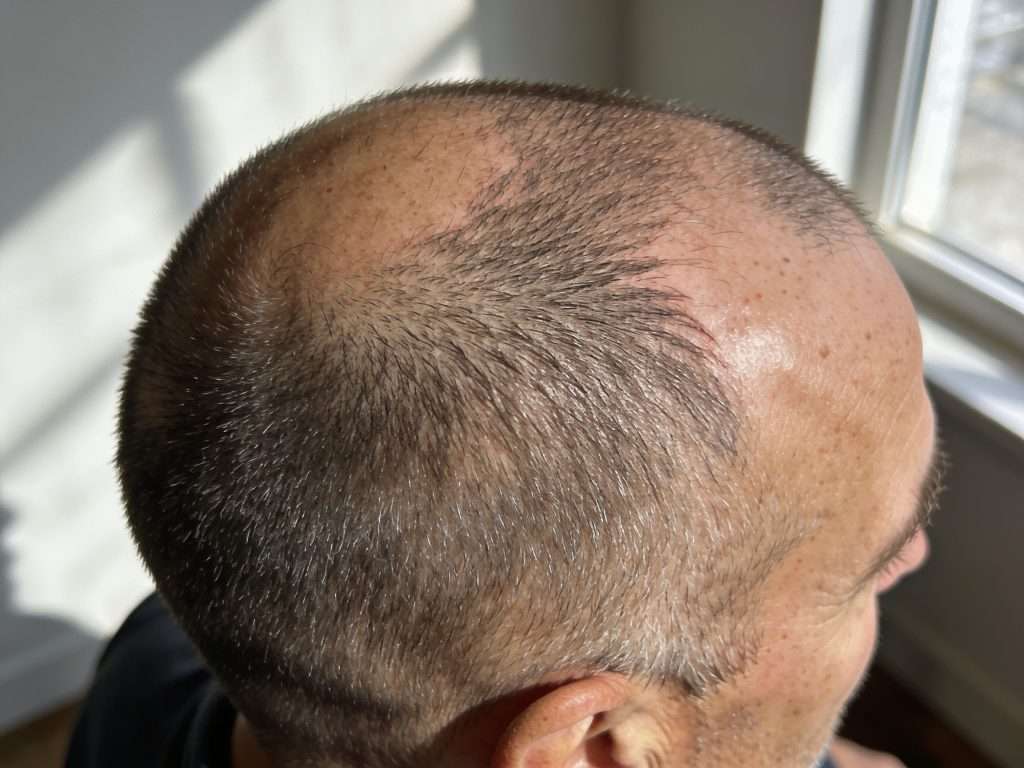
5 things to expect from your SMP density sessions
You’ve done the research, you know what SMP can do, and now you’re wondering what the actual process looks like from first appointment to finished result. How many sessions? What will your scalp look like in between? When does it start looking the way it’s supposed to? This article answers all of that with real timeframes, not reassuring generalities.
1. Most men need two to four sessions, not one
SMP density treatment for male pattern hair loss is built across multiple sessions rather than completed in a single appointment. Most men need two to four sessions in total, depending on the extent of the thinning, their skin type, and how the pigment takes in the first round.
Each session lasts anywhere from one to five hours. The first session deposits an initial layer of pigment dots at a lower density, around 40 dots per square centimetre, to establish the foundation. Subsequent sessions progressively build that density up to 80 to 100 dots per square centimetre, layering depth and dimension into the result.
Trying to achieve the full effect in one sitting is not how this works, and any practitioner who promises a single-session finish for significant hair loss should be questioned. The layered approach exists for good reason: it allows the pigment to settle and be assessed honestly before more is added.
2. Sessions are spaced several weeks apart, on purpose
Each session needs to be separated by a minimum of two to four weeks. This is not a scheduling inconvenience; it is essential to the process. Your scalp needs time to heal, and the pigment needs time to settle before an accurate assessment can be made.
What looks dense immediately after a session will lighten and soften as the skin heals. Epidermal pigment clears through natural skin turnover in roughly 27 days. What remains after that is the dermal layer, and that is the true baseline you are working with before the next session is applied.
Rushing sessions together means building on pigment that has not settled, which makes it almost impossible to judge depth, tone, or distribution accurately. The spacing is not padding the schedule; it is the schedule working correctly.
3. The first few days post-session look darker than the final result
This is one of the most important things to understand before you sit in the chair. Immediately after your first session, the treated area will look noticeably darker and more saturated than it will once healed. The dots are sharper, the pigment is sitting at the surface, and redness from the treatment may add to the intensity.
That initial redness typically subsides within two to three days. Over the following two to four weeks, the pigment softens, lightens slightly, and settles into the skin at a more natural appearance. This is normal and expected. It is not fading that you need to worry about; it is the skin doing exactly what it should.
By the time you come in for your second session, the result will look noticeably more subtle than it did on day one. That is when the next layer can be assessed properly and applied with precision.
4. The scalp micropigmentation healing timeline follows a clear sequence
Understanding the healing timeline removes much of the uncertainty from the process. Here is how it typically progresses after each session:
- Days 1 to 4: No water on the scalp, no shampoo, no sweating, no shaving. The scalp is healing and the pigment is settling. Leave it completely alone.
- Days 5 to 10: Gentle washing is fine. Avoid direct sun exposure; UV light is one of the primary drivers of pigment fading over the long term, and the scalp is still vulnerable at this stage.
- Day 10 onwards: You can resume normal grooming, including shaving if that is part of your look. Apply SPF 30 to 50 to the scalp whenever you are outdoors.
- Day 28: Full healing is considered complete after the final session. Avoid swimming pools for the full 28 days, as chlorine and prolonged water exposure interfere with pigment retention.
This timeline applies after each session, not just the last one. Following it carefully between appointments makes a real difference to how the pigment retains and how consistent your results are across the full treatment course.
5. The final result takes up to a month to fully reveal itself
Once your last session is done, the instinct is to judge the result immediately. Try not to. The scalp needs a full 30 days to heal completely, and what you see at day one is not what you will see at day 30.
The completed result, once fully healed, is a consistent, even distribution of pigment that replicates the appearance of closely cropped hair follicles across the thinning area. In a 2025 case series from Chongqing Medical University, patients with androgenetic alopecia reported visual density scores averaging 8.7 out of 10 immediately after treatment, settling to 7.7 at six months. That modest settling is normal and, for most men, the six-month result remains highly satisfying.
A note on pain: numbing cream is not used as standard, but you are welcome to apply a topical anaesthetic beforehand if you would prefer. Most clients find the sensation manageable without it, particularly once they know what to expect, but the choice is entirely yours.
Long-term, results typically last three to five years before a touch-up is worthwhile. Sun exposure, skin type, and how consistently you apply SPF all influence that timeline. Factoring in a touch-up every few years is the realistic way to think about the long-term cost of the treatment.
Frequently Asked Questions
How many SMP sessions are needed for a male density treatment?
Most men require two to four SMP sessions for a density treatment, depending on the extent of hair loss and how their skin responds. Sessions are spaced several weeks apart to allow healing and accurate pigment assessment before each subsequent layer is applied.
What does the scalp look like immediately after an SMP density session?
Immediately after an SMP session, the pigment appears darker and more saturated than the final healed result. Redness typically subsides within two to three days, and the pigment softens and lightens over the following two to four weeks as the skin completes its natural healing process.
How long does the scalp micropigmentation healing timeline take?
The scalp micropigmentation healing timeline runs approximately 30 days after the final session. Days 1 to 4 require no washing or sweating. Days 5 to 10 allow gentle washing but no sun exposure. From day 10, normal grooming resumes with daily SPF. Swimming pools should be avoided for 28 days.
Does SMP density treatment require numbing cream?
Numbing cream is not used as standard during SMP density treatment, but clients are welcome to apply a topical anaesthetic beforehand if they prefer. Most men find the sensation manageable without it, particularly once they understand what to expect from the procedure and session length.
How long do SMP density results last before a touch-up is needed?
SMP density results typically last three to five years before a touch-up is worthwhile. Longevity depends on sun exposure, skin type, and consistent SPF use. Clients with oily skin or high sun exposure may find pigment fades sooner, while dry skin and regular SPF application support longer-lasting results.