
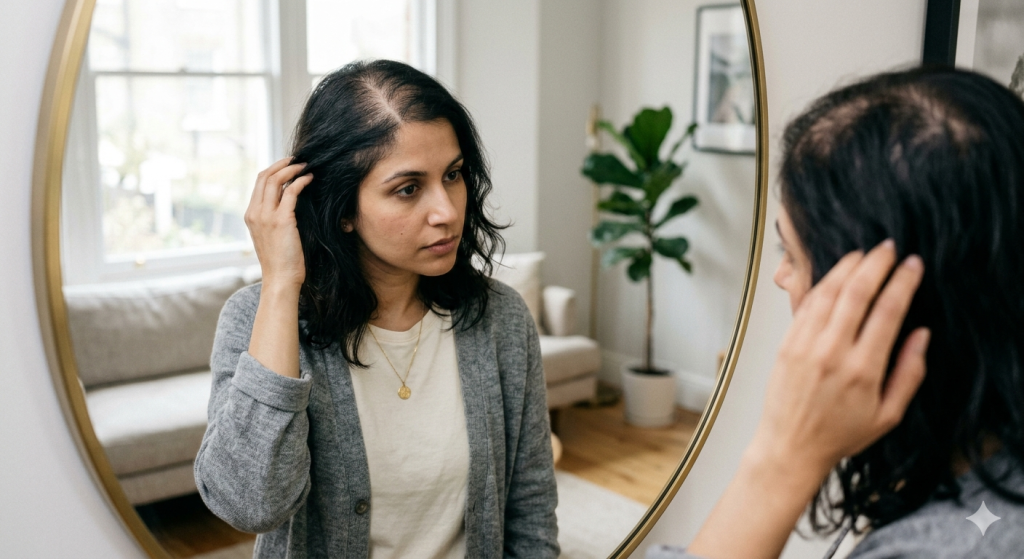
Postpartum hair loss and SMP: what actually works
You’ve come out the other side of pregnancy, and now your hair is falling out in handfuls. It feels deeply unfair, and for many women it’s more distressing than they expected. This article explains what postpartum hair thinning actually involves, when SMP density treatment becomes a sensible option, and how to time it for the best possible result.
What’s actually happening to your hair after pregnancy
During pregnancy, elevated oestrogen levels keep more of your hair in its growth phase than usual. Your hair looks thicker, shinier, fuller. Then, typically between six weeks and four months after giving birth, those oestrogen levels drop sharply, and all that retained hair sheds at once. It’s called telogen effluvium, and it’s one of the most common hair loss after pregnancy experiences women go through.
For most women, shedding peaks around three to four months postpartum and then gradually slows. What’s left behind, though, is often noticeably thinner than before, particularly at the temples, the crown, and along the parting. That’s where the emotional weight tends to settle. Hair is deeply tied to how many women feel in themselves, and watching it thin after an already demanding physical experience can be genuinely hard.
Hormonal recovery takes time. In many cases, hair density improves naturally over the following twelve to eighteen months. But for women with a predisposition to fine hair, androgenetic alopecia, or more significant hormonal shifts, that recovery may be incomplete. That’s the point at which a targeted postpartum hair thinning treatment starts to make real sense.
What SMP density treatment does and doesn’t do
SMP, or scalp micropigmentation, deposits tiny points of pigment into the scalp between your existing hair follicles. For women with thinning hair, this isn’t about creating a cropped or shaved appearance. The goal is to reduce the visual contrast between your hair and your scalp, making the overall effect look denser and fuller without touching your hair length or style at all.
When hair thins, it’s often not the number of strands that changes dramatically but the visibility of the scalp beneath them. SMP closes that gap. Pigment is placed with fine, precise dots that mimic the appearance of follicles at skin level, filling in the gaps optically. Done well, it’s subtle: the kind of change where people notice you look well rather than noticing the treatment itself.
What SMP doesn’t do is stimulate regrowth. It works with the hair you have, not instead of treatments like minoxidil or nutritional support that address the follicle directly. For many women, using both in combination gives the best of both worlds: SMP improves visible density straight away, while other approaches support longer-term regrowth beneath the surface.
When to consider SMP after having a baby
Timing matters here, and it’s something I discuss carefully with every client who comes to me postpartum. The general guidance is to wait until your hormonal picture has stabilised, typically at least nine to twelve months after giving birth, and longer if you’re still breastfeeding, which can itself delay the return of a regular hormonal cycle.
The reason for this isn’t arbitrary caution. If significant regrowth is still happening when we treat, the scalp’s appearance is still changing. Treating too early can mean the distribution of pigment looks different once that new hair comes through. Waiting until the shedding has fully stopped and any natural regrowth has settled gives us a clearer, more stable canvas to work with, and that leads to a better, longer-lasting result.
That said, every woman’s timeline is different. Some clients come to me at eight months postpartum with stable shedding and a clear picture of what’s remained. Others are still seeing fluctuation at fourteen months. A proper consultation, looking at your hair history, current shedding patterns, and any ongoing hormonal factors, is always the right starting point before committing to a treatment date.
What the treatment process involves
For female density SMP, your hair stays exactly as it is. There’s no shaving, no significant preparation beyond keeping the scalp clean and free of product on the day. I don’t use numbing cream as standard, but if you’d prefer to apply one beforehand, that’s absolutely fine: just let me know ahead of your appointment and I’ll advise on timing.
Most density treatments are completed across two sessions, spaced around four to six weeks apart. The first session lays the initial pigment foundation; the second refines the depth, tone, and distribution once we can see how your skin has healed and how the pigment has settled. Some clients benefit from a third session, but that’s something we assess together rather than assume from the start.
The results are gradual in the best sense: natural-looking, building session by session rather than arriving all at once. Aftercare is straightforward, and I’ll walk you through exactly what to do and what to avoid after each appointment. You’re never left to figure it out alone.
Frequently Asked Questions
How long after giving birth can I have postpartum hair loss SMP?
Most practitioners recommend waiting at least nine to twelve months postpartum before considering SMP density treatment. This allows hormonal levels to stabilise and natural regrowth to settle. If you’re breastfeeding, waiting until after you’ve finished is often advisable, as lactation can delay your hormonal cycle returning to its pre-pregnancy baseline.
Will SMP work if my postpartum hair thinning is still active?
SMP produces the best results when shedding has stopped and your hair density has stabilised. Treating during active postpartum hair thinning means the scalp’s appearance is still changing, which can affect how the pigment distribution looks once regrowth occurs. A thorough consultation before booking helps establish whether your hair is ready for treatment.
Does SMP look natural on women with longer or styled hair?
Yes, female density SMP is specifically designed for women who keep their hair at natural length. Pigment is placed between existing follicles to reduce scalp visibility, not to create a cropped appearance. When done well, the result looks like naturally fuller hair rather than a noticeable procedure: subtle enough that others simply notice your hair looking better.
Can I combine SMP with other hair loss after pregnancy solutions?
Absolutely. SMP works well alongside treatments such as minoxidil, nutritional supplementation, or medical microneedling, which address follicular health and regrowth directly. SMP improves visible density straight away, while other approaches support longer-term recovery. Combining them gives you both an immediate visual result and a strategy for improving hair quality over time.
Is scalp micropigmentation painful for women undergoing postpartum treatment?
Most women describe the sensation as mild and manageable, similar to light scratching. Numbing cream isn’t used as standard, but if you’d prefer to apply one beforehand, that’s completely fine and something we can plan for at your consultation. Sessions are paced to keep you comfortable throughout, and most clients find it far easier than expected.