
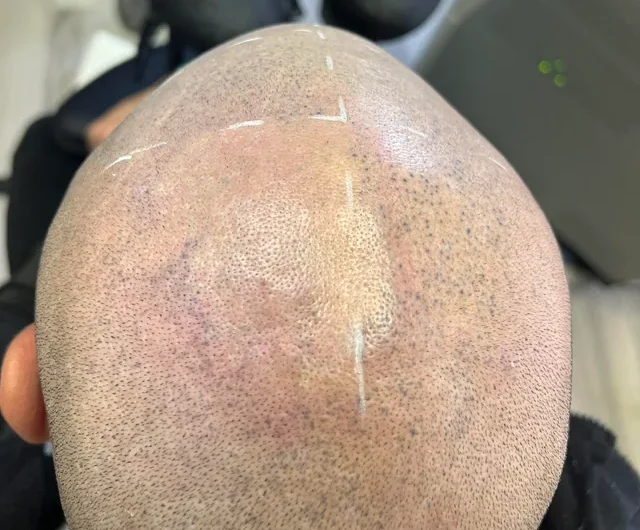
5 things laser removal can actually fix on a bad SMP hairline
You looked in the mirror and something felt off about your SMP hairline. Maybe it’s sitting too low, too straight, or just not right for your face. This article covers exactly what laser removal can fix, how the process works, and what realistic correction looks like from start to finish.
1. A hairline that sits in the wrong position
The most common reason clients come to me for SMP hairline removal is placement. A hairline that’s too low can make the whole result look unnatural, even if the individual dots are perfectly executed. Too high and it can look sparse or disconnected.
Laser removal breaks down the pigment beneath the surface, allowing those misplaced marks to fade. Once the area is sufficiently clear, a redesigned hairline can be placed at the correct position for your facial proportions. This is a proper two-stage correction: remove first, rebuild second.
2. A hairline that looks too sharp or artificial
A well-executed SMP hairline should have a soft, irregular edge that mimics the way real hair grows. If yours looks more like a drawn line than a natural hair pattern, that’s a design issue. Hard, perfectly uniform hairlines are one of the most visible signs of SMP that hasn’t been done well, and they’re difficult to soften without laser intervention.
Frontal hairline removal using laser can target just the outermost edge of the work, fading those hard-edged dots so the perimeter can be rebuilt with a softer, more scattered technique. In some cases, only partial removal is needed rather than clearing the entire frontal area.
3. Pigment that has changed colour or migrated over time
Not all SMP pigments are created equal. The correct pigment for SMP should be carbon-based (CI 77266) or a purpose-formulated SMP pigment. When the wrong pigments are used, or when older formulations begin to break down, the colour can shift to blue, green, or even purple. This is more common in older work, and it’s one of the reasons more clients are now choosing to laser off previous SMP before a fresh procedure.
The Nd:YAG laser is the most widely used for carbon-black SMP pigments, as it targets dark particles effectively without excessive trauma to the surrounding skin. Different laser types may be more appropriate for non-standard pigments, which is why understanding what was used originally matters at the consultation stage.
4. An inappropriate side profile or temple shape
The sides of a hairline matter just as much as the front. A temple shape that drops too aggressively, sweeps in the wrong direction, or simply doesn’t suit your natural recession pattern can look mismatched even when the frontal work is reasonable. The side profile of an SMP hairline is often what gives the result away at a glance.
Hairline correction laser work in these areas requires precision, because the skin around the temples can be thinner and the transition zone is visible from multiple angles. A trained practitioner will assess whether full removal or selective fading is the better route before redesigning the temple shape to suit your actual facial structure.
5. SMP you simply no longer want
Not every removal is about poor execution. Sometimes the work is technically fine but your circumstances have changed: you want a lighter result, your style preferences have shifted, or you’d like to freshen the whole thing with a more modern approach. This is increasingly common as SMP techniques have improved significantly, and clients who had work done several years ago are choosing to start again with updated methods.
Wanting to remove or adjust your SMP for personal reasons is entirely valid, and it doesn’t require the original work to have been a disaster. Laser sessions can be used to lighten existing SMP so a new procedure sits more cleanly on top, rather than building layer upon layer. A consultation will establish how many sessions are likely needed based on your pigment depth and how much fading is required.
Whatever the reason behind your removal, the most important thing is that you’re working with someone qualified to assess your specific situation. Lasers are serious medical devices and the wrong settings, or the wrong hands, can cause scarring, hypopigmentation, or incomplete results. Always check that your practitioner holds a recognised laser qualification, not just a general aesthetics background. A reputable SMP specialist will either handle laser removal themselves or refer you to someone they trust.
Frequently Asked Questions
How many laser sessions does SMP hairline removal typically take?
Most SMP hairline removal cases require between three and eight sessions, spaced six to eight weeks apart to allow the skin to recover and the pigment to clear. The exact number depends on pigment depth, the original technique used, and whether you’re aiming for full removal or just enough fading for a corrective procedure on top.
Does laser removal of an SMP hairline hurt?
Most clients describe it as a quick, sharp sensation, similar to a rubber band snapping against the skin. Numbing cream isn’t used as standard, but you’re welcome to apply a topical anaesthetic beforehand if you’d prefer some extra comfort. The frontal hairline area is generally more sensitive than the crown, so it’s worth factoring that in.
Can laser removal leave scarring on the scalp?
In the wrong hands, yes. Incorrect laser settings, too many passes in a single session, or using a laser unsuited to SMP pigments are all risk factors for scarring or skin texture changes. Choosing a qualified laser practitioner who specialises in SMP removal, rather than a general tattoo removal clinic, significantly reduces that risk.
What laser is used for SMP hairline removal?
The Nd:YAG laser is the most commonly used for SMP removal, particularly for carbon-based pigments (CI 77266), which are the correct pigment type for scalp micropigmentation. If a non-standard pigment was used in your original procedure, a different laser wavelength may be more appropriate, and this is assessed during your consultation.
Is it possible to have a new SMP hairline designed after laser removal?
Yes, and for many clients that’s exactly the goal. Once the old pigment has faded sufficiently through laser sessions, a fresh SMP procedure can be carried out with a redesigned hairline that suits your facial proportions and uses current techniques. The laser essentially gives you a clean canvas rather than correcting on top of existing work.