
Crown thinning in women: can SMP actually deliver?
You can see it in certain lights, in photos, in the mirror on a bad morning: a wider parting, a paler scalp through the top of your hair, a thinning patch at the crown that feels increasingly hard to hide. If you’ve been wondering whether scalp micropigmentation could actually help, this article gives you a clear answer. You’ll know exactly how SMP works for women, what to expect, and whether it suits your situation.
Why crown thinning is different for women
Female hair loss most commonly presents at the crown and vertex, the top of the scalp, rather than as a receding hairline. For many women, the hairline stays intact while the parting gradually widens and the scalp becomes more visible through the hair above. This is typical of female-pattern hair loss, though hormonal shifts, postpartum shedding, stress, nutritional deficiency, and conditions such as alopecia can all contribute.
The emotional weight of it is real. Hair carries enormous cultural and personal significance for women, and thinning at the crown is particularly difficult to conceal with styling alone. Dry shampoo and volumising spray only go so far. Options like wigs, topical fibres, and medications exist, but many women want something more reliable and lower-maintenance.
That’s where SMP becomes worth understanding properly.
What SMP for female crown thinning actually involves
SMP, scalp micropigmentation, uses a specialist device and carefully matched pigments to place tiny impressions of colour into the upper layers of the scalp, replicating the appearance of hair follicles and adding depth between existing hairs. For women with crown thinning, this creates the illusion of greater density, so the scalp becomes far less visible through the hair.
Critically, this is a density treatment and your hair stays exactly as it is. There’s no shaving required. The SMP sits beneath your existing hair, darkening the scalp tone so that the contrast between skin and hair is reduced. The result is a more uniform appearance at the crown and a parting that looks naturally full rather than wide and pale.
The technique used for women is quite different from the close-cropped look associated with other SMP applications. The work here is all about subtlety: matching the pigment precisely to your natural hair colour, layering the impressions at the right depth and spacing, and blending seamlessly into the areas where your hair is still thick. Done well, it’s undetectable.
The consultation and treatment process
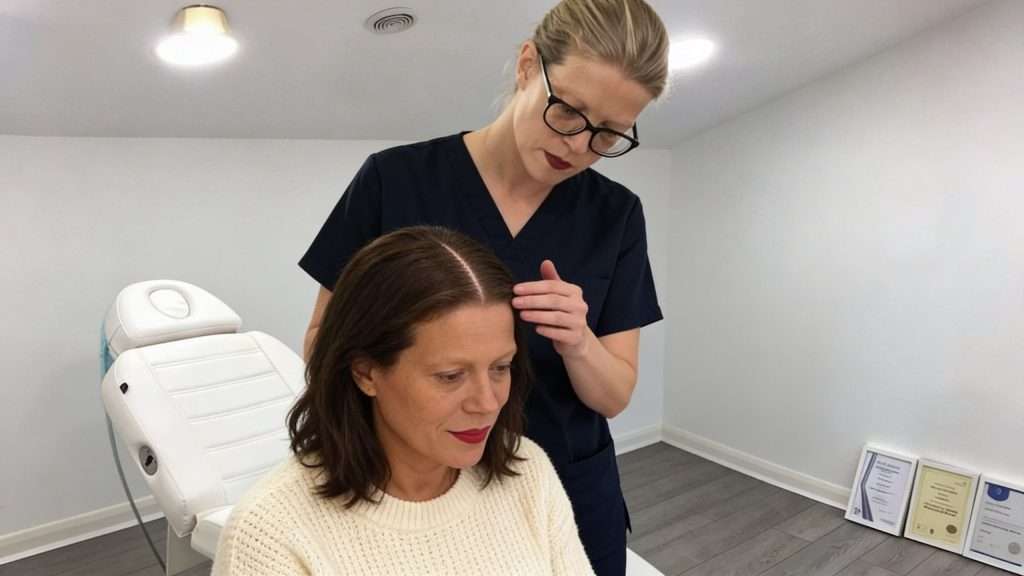
A thorough consultation is the starting point for any SMP treatment. During this conversation, I’ll look closely at your crown area, discuss your hair loss pattern, and talk through what you’d like to achieve. It’s also the moment to ask every question you have. Nothing is too small, and I want you to feel completely clear on what the process involves before we go anywhere near treatment.
I don’t use numbing cream as standard, but if you’d prefer to apply it beforehand, that’s absolutely fine. Just let me know ahead of your appointment. Most clients find the treatment very manageable, and the crown and vertex area is generally well-tolerated.
Treatment is typically carried out across two to three sessions, spaced several weeks apart. This staged approach allows the pigment to settle and gives us the opportunity to build density gradually, adjusting tone and placement as we go. It’s a far more controlled result than trying to achieve everything in a single sitting.
Aftercare is straightforward but does matter. I’ll talk you through everything at your appointment and I’m always available if questions come up during healing. You’ll notice the pigment soften slightly as it settles, which is completely normal and fully accounted for in the treatment plan.
Is SMP the right vertex thinning solution for you?
SMP works best when you still have hair present at the crown, even fine or sparse hair. The treatment works with what you have, not in place of it. If your hair is completely absent in a defined patch, SMP can still significantly reduce scalp visibility, though the approach will be tailored accordingly during consultation.
It isn’t a medical treatment and it won’t stimulate regrowth. If an underlying cause of your hair loss is active and untreated, it’s worth exploring that alongside SMP rather than instead of it. Some clients combine SMP with medical microneedling, which can support scalp health and hair retention. That’s something I can discuss with you based on your individual situation.
What SMP does offer is a durable, low-maintenance, genuinely confidence-restoring female crown hair loss treatment. The parting looks fuller. The scalp looks less exposed. And you don’t have to think about it every morning. For many women, that shift is significant.
Frequently Asked Questions
Will SMP for crown thinning look natural in women with longer hair?
Yes, when performed correctly, SMP for female crown thinning is designed to be undetectable. The pigment sits beneath your existing hair, reducing scalp visibility rather than creating a shaved appearance. Precise colour-matching and careful layering ensure the result blends naturally with longer hair at any parting angle.
How many SMP sessions will I need for crown thinning?
Most women with crown thinning need two to three SMP sessions, spaced several weeks apart. This staged approach allows the pigment to settle between visits and gives your practitioner the control to build density gradually, refine the tone, and ensure the result looks completely natural before the treatment is considered complete.
Does SMP treatment for vertex thinning hurt?
The crown and vertex area is generally well-tolerated by most clients. Numbing cream isn’t used as standard, but you’re welcome to apply it beforehand if you’d prefer. Sensation varies between individuals, but the majority of women describe it as manageable rather than painful, and sessions are paced to keep you comfortable throughout.
Can SMP help if my female hair loss is still progressing?
SMP can still be beneficial even if your hair loss is ongoing, but it’s worth discussing the cause during your consultation. If an underlying condition is active, addressing it medically alongside SMP gives you the best outcome. Top-up sessions can also be used over time to maintain density as your hair changes.
How long does scalp micropigmentation last for crown thinning in women?
SMP typically lasts three to six years before a refresh is needed, though this varies depending on skin type, sun exposure, and aftercare. The pigment fades gradually rather than changing colour abruptly. Most women find the result remains convincing for several years with minimal maintenance between their initial treatment and any future top-up.