
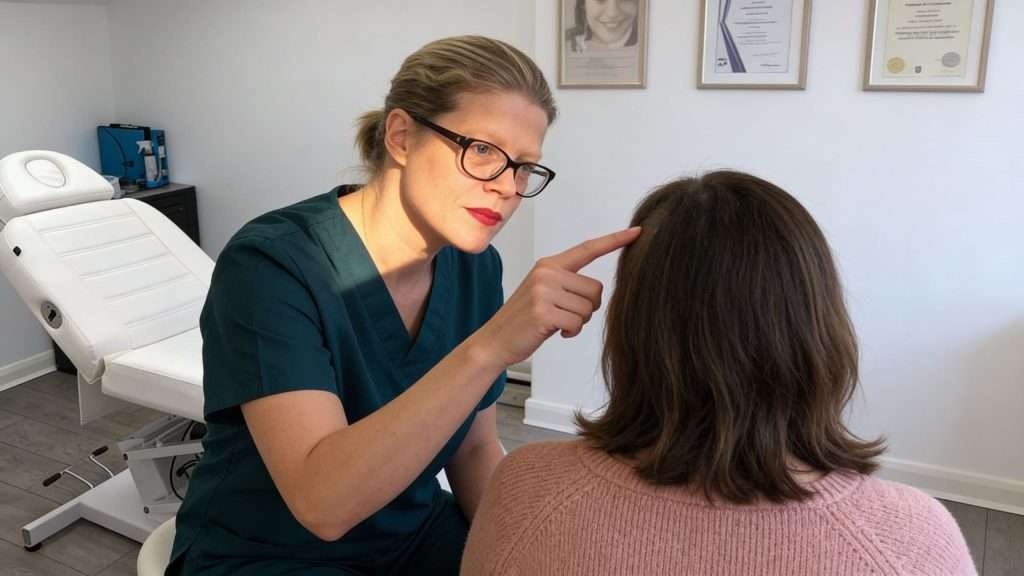
5 things every woman with telogen effluvium needs to know about SMP
Your hair is coming out in handfuls and you’re caught between waiting it out and doing something about it now. Telogen effluvium, the diffuse shedding triggered by stress, illness, or hormonal shifts, is one of the most distressing hair loss conditions women face. SMP can add the appearance of fuller, denser hair without shaving or disrupting regrowth. Here’s what you need to know before taking the next step.
1. SMP adds visual density without touching your existing hair
Scalp micropigmentation for women with telogen effluvium works by placing tiny pigment impressions between your existing hairs, creating the appearance of a fuller, denser scalp. It doesn’t require shaving, and it doesn’t interfere with regrowth. Your natural hair stays exactly as it is.
The result is a reduction in the contrast between your hair and scalp, which is what makes thinning so visible in the first place. For many women, that contrast is the thing they find hardest to look at in the mirror.
2. Telogen effluvium is temporary, but the anxiety around it isn’t
Telogen effluvium is classified as a temporary hair loss condition. The shed usually peaks two to three months after the trigger, whether that’s a stressful event, surgery, rapid weight loss, or a thyroid disruption, and hair typically begins returning within six months. Knowing that doesn’t make it easier to live through.
The emotional weight of visible hair loss for women is real and significant. Hair is deeply tied to identity, femininity, and how we present ourselves in professional and personal spaces. It’s completely valid to want a solution that works now, not just eventually.
3. Timing matters: wait for the shed to stabilise first
This is the most important practical point. SMP works best as a temporary hair loss solution for women when the shedding has settled. If your hair is still actively falling out in large amounts, the density created today may not reflect the density you’ll have in three months.
A good rule of thumb: if your daily shed has reduced noticeably over four to six weeks and you’re seeing signs of short regrowth, you’re likely in a stable enough phase to consider SMP. A thorough consultation, and ideally a conversation with your GP or a trichologist, will help confirm this.
4. SMP works alongside regrowth, not instead of it
One of the things I find genuinely reassuring to explain to clients is that SMP and regrowth aren’t in competition. As your hair returns, the pigment impressions integrate with new growth rather than becoming obsolete. The two work together, which means you’re not locked into anything.
Some women find that the visual confidence SMP gives them actually reduces the stress feedback loop that can perpetuate shedding. Stress hair loss in women often has a psychological dimension that’s hard to break out of. Feeling better about how your scalp looks can be part of the recovery, not a vanity sidetrack.
5. Not every practitioner understands diffuse thinning in women
Female density SMP for diffuse conditions like telogen effluvium requires a different approach than other SMP treatments. The goal isn’t a defined hairline or bold coverage. It’s subtle, layered impression work that respects your existing hair pattern and looks completely natural in unshaved hair.
Ask your practitioner specifically about their experience with women and diffuse thinning. Ask to see healed results, not just fresh treatment photos. The pigment placement, depth, and colour matching for this kind of work needs to be precise, because it has to blend into hair that’s already there rather than define a shape from scratch.
Telogen effluvium is hard enough without feeling like your only options are waiting or rearranging your hair every morning to hide the gaps. SMP offers a real, low-commitment way to reclaim how you look while your hair does what it needs to do.
Frequently Asked Questions
Is SMP a permanent solution for telogen effluvium hair loss in women?
SMP is long-lasting but not permanent. Pigment gradually lightens over several years and can be refreshed as needed. For women with telogen effluvium, where regrowth is expected, SMP works as a supportive measure during thinning rather than a lifelong fix, and it adapts well as your hair density changes over time.
Will SMP look natural on diffuse thinning caused by stress or illness?
Yes, when performed by a practitioner experienced in female density work. The technique uses fine pigment impressions placed between existing hairs to reduce scalp-to-hair contrast. The result mimics the look of natural density rather than creating obvious marks, and it works within unshaved hair so nothing looks out of place.
How do I know if my telogen effluvium has stabilised enough for SMP?
A reliable sign is that your daily shed has reduced consistently over four to six weeks and you can see short new hairs coming through. If shedding is still heavy, it’s worth waiting. A consultation, ideally alongside advice from a GP or trichologist, will give you the clearest picture of your readiness for treatment.
Can SMP help with stress-related hair loss in women specifically?
Yes. Stress hair loss in women often causes diffuse thinning across the crown and parting, which is exactly what density SMP is designed to address. By reducing the visible contrast between scalp and hair, SMP can restore the appearance of fullness and ease some of the anxiety that comes with visible thinning during recovery.
Does SMP treatment for telogen effluvium affect hair regrowth?
No. Female density SMP works at the surface of the scalp and does not interfere with hair follicles or the regrowth cycle. Pigment is placed in the upper layers of the skin between existing hairs. As your hair returns following telogen effluvium, it grows through naturally alongside the pigment rather than being affected by it.