
If you’re considering scalp micropigmentation in London and you’re not quite sure what the process actually involves, you’re in the right place. I get asked this question a lot, and honestly, it’s one of my favourite things to talk about.
Understanding exactly what’s going to happen, from your first enquiry through to your finished result, makes such a difference to how you feel walking through the door. So let me walk you through the whole journey, as we do it here at Simply Scalp.
It Starts with a Conversation
Before anything else, we have a consultation. This isn’t a sales pitch or a quick five-minute chat. It’s a proper conversation where I get to understand your hair loss, your lifestyle, your expectations, and what you’re hoping to achieve. Whether you’re dealing with a receding hairline, diffuse thinning, or complete hair loss, every situation is different and the treatment plan should reflect that.
This is also your chance to ask every question you have. No question is too basic or too specific. I want you to feel completely comfortable and confident before we even think about booking your first session.
How Many Sessions Will You Need?
One of the most common questions I get asked is how many sessions SMP takes. Regardless of the extent of your hair loss, all clients at Simply Scalp require 3 sessions to achieve the best possible result. This is not something I ever cut corners on.
Here’s why 3 sessions matter:
- Session 1 lays the foundation. We establish the hairline design, the overall shape, and begin building the base pigment layer across the treatment area.
- Session 2 adds depth and density. Once the skin has healed and the pigment has settled, we layer up the treatment to create a more realistic, three-dimensional appearance.
- Session 3 is where everything comes together. This is the refinement session. We make any final adjustments, perfect the hairline, and ensure the result is exactly where it needs to be.
Sessions are spaced apart to allow proper healing between each one. Rushing this process would compromise the outcome, and that’s simply not something I’m willing to do.
What Actually Happens During a Session?
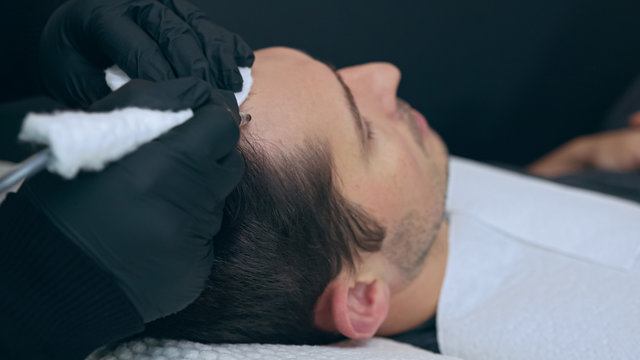
During each session, I use a specialist needle and pigment to place thousands of tiny impressions into the upper layers of the scalp. Each one is carefully positioned to replicate the look of a real hair follicle. The result, when done well, is completely indistinguishable from a freshly shaved head of hair.

Sessions typically last anywhere from two to four hours depending on the size of the treatment area and the stage of the process. You’ll be lying back in a comfortable treatment chair, and most clients find the time passes surprisingly quickly.
Is SMP Painful?
This is the question I hear most often, and the honest answer is that the vast majority of clients find the treatment very manageable. Pain levels are generally low, and almost every client I’ve treated has been completely comfortable throughout their sessions without any intervention.
Everyone’s pain threshold is different, and some areas of the scalp are naturally more sensitive than others. The top and back of the head tend to be the most comfortable areas, while the temples and hairline area can feel a little more sensitive. That said, most clients describe the sensation as mild and very tolerable, often much less than they expected.
If you’re concerned about comfort, you’re welcome to take over-the-counter oral pain relief available in the UK before your session. I’d always recommend speaking to your GP or a suitable healthcare professional before doing so, as I’m not in a position to advise on medication.
Choosing the Right Hairline Design
The hairline design is arguably the most important decision in the entire process. A poorly designed hairline can look unnatural or age badly, and that’s why I take real time over this with every single client.
A good hairline needs to suit your face shape, your age, your skin tone, and crucially, it needs to look appropriate for the years ahead. I’ll never push you towards something that looks too sharp, too low, or too unrealistic. The goal is always a result that people simply cannot detect.
We’ll agree the design together before any pigment is placed, so you’ll always know exactly what you’re getting.
Pigment Colour and Skin Tone
Getting the pigment colour right is a skill that comes with experience. At Simply Scalp, I custom-mix pigments to match your natural hair colour and complement your skin tone. This is not a one-size-fits-all process.
One thing worth knowing is that pigment appears slightly darker immediately after each session before softening as the skin heals. This is completely normal and is factored into the treatment plan. By the time you’ve completed all 3 sessions and the final result has settled, the colour should sit perfectly.
What to Expect After Each Session
Aftercare is a crucial part of getting the best result, and I’ll give you clear, specific guidance after every session. In the days following treatment, you can expect:

- Some redness and mild sensitivity in the treated area, which usually settles within 24 to 48 hours
- The pigment to appear bolder and darker than the final result will be
- Some light flaking or dryness as the skin heals
You’ll need to keep the scalp dry for a few days, avoid intense exercise, swimming, and direct sun exposure during the healing period. It’s a fairly straightforward aftercare routine, and most clients fit it into their lives without any real disruption.
When Will You See the Final Result?
The honest answer is that you won’t see the full, finished result until after your third session has healed. Each session builds on the last, and the transformation is gradual and intentional. I know it can feel like a lot of patience is required, but the three-session structure is genuinely what produces results that last and look right long-term.
Once your final session has settled, the result is there to enjoy. Most clients describe the confidence shift as significant. Whether it’s walking into a room differently, stopping wearing hats, or simply not thinking about their hair the moment they wake up, those are the moments that remind me exactly why I do this work.
Why London, and Why Simply Scalp?
London has no shortage of options when it comes to SMP, which makes choosing the right clinic all the more important. What sets Simply Scalp apart isn’t just the quality of the work, it’s the entire experience. From your first consultation to your final session, you’re treated as an individual with specific needs, not just another appointment in the diary.
I founded Simply Scalp because I genuinely believe that everyone deserves to feel good about how they look, and I care deeply about every result that leaves my clinic. This is not a volume business. Every hairline is designed with intention, every session is delivered with precision, and every client relationship matters to me personally.
If you’re based in London or travelling in for treatment, I’d love to hear from you. A consultation is the natural starting point, and it costs nothing to have that conversation.
Frequently Asked Questions
Q1: How long does each SMP session take?
Session length varies depending on the size of the treatment area and which session in the process you’re attending. Generally, sessions run between two and four hours. Your first session tends to take a little longer as it involves establishing the hairline design and laying the initial pigment foundation. Subsequent sessions are often slightly shorter, though the third and final refinement session can also take a bit more time as we focus on perfecting every detail. You’ll always have a clear idea of what to expect on the day when you book in.
Q2: How many sessions does SMP require?
All clients at Simply Scalp complete 3 sessions, regardless of the level of hair loss. This is not something that changes based on how much hair you’ve lost. The three-session process exists because each session plays a specific role, from laying the foundation, to adding depth and density, through to final refinement and perfection. Skipping or combining sessions would compromise the result, and that’s not an approach I’m willing to take. The sessions are also spaced apart to allow proper healing between each one, which is essential for pigment retention and long-term quality.
Q3: Will SMP look natural on my skin tone?
Yes, absolutely. One of the most important parts of the process is colour matching, and it’s something I take very seriously at Simply Scalp. Pigments are custom-mixed to complement your individual skin tone and match your natural or existing hair colour as closely as possible. The technique is also adapted to suit different skin types, including darker skin tones, which require particular care and experience to treat well. The goal is always a result that looks completely undetectable, as if you simply have a very close shave. When the pigment colour, placement, and hairline design are all done correctly, the result is indistinguishable from real hair follicles.
Q4: Can I take pain medication before my SMP appointment?
If you’d like to take over-the-counter oral pain relief before your session, that’s entirely your choice, and some clients do find it helpful. However, I’m not able to advise on which medications to take or in what dosage, as that’s outside of my scope. I’d always recommend speaking to your GP or a qualified healthcare professional before taking anything, particularly if you have any existing health conditions or are taking other medications. What I can tell you is that the vast majority of clients find SMP treatment very comfortable without any preparation, and pain levels are generally much lower than people expect.
Q5: How long do SMP results last?
Scalp micropigmentation is a long-lasting treatment, but it is not completely permanent. Over time, and typically over a period of several years, the pigment will naturally fade due to factors including sun exposure, skin type, and general skin cell turnover. Most clients find their results remain looking great for anywhere between three and six years before a refresh session might be considered. How you care for your scalp after treatment, particularly protecting it from UV exposure, will have a significant impact on longevity. I’ll always give you thorough aftercare guidance to help you get the most from your results for as long as possible.
Q6: What is the healing process like between sessions?
Healing between sessions is generally straightforward. In the first 24 to 48 hours after treatment, the scalp may feel a little sensitive and appear slightly red, which is completely normal. The pigment will also look darker than the final result during this period, as it hasn’t yet softened and settled into the skin. You’ll need to keep the treated area dry, avoid swimming, heavy exercise, and direct sun exposure for a few days. Light flaking can also occur as the skin naturally renews itself. I provide detailed aftercare instructions after every session, so you’ll always know exactly what to do and what to expect during the healing phase.